Bandai's proprietary format, and what "Perfect Cell at 99990" really was
日本語 | English | Français | Español | Italiano | 한국어
Scan every product in the house and the stats that come back are uniformly feeble. Most people who played with a Datach remember it that way. Pages 1 through 3 of this site explain why, from the retail-barcode side.
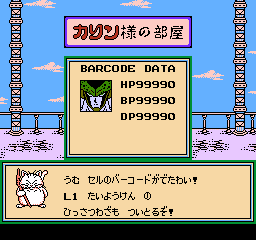
But feed it certain genuine Bandai cards and numbers appear that no retail product can reach. Perfect Cell with HP, BP and DP all reading 99990 — or so the story goes.
This began with a tip from Tareichi (@tareichi001): that the Dr. Wily card from Super Barcode Wars: Rockman 5 produces HP, BP and DP all at 99990. Not a Dragon Ball card at all — a Rockman (Mega Man) card, from Capcom's series. What was actually going on is the subject of this page.
The short version: retail JAN/EAN codes are not the only thing the Datach can read. There is a second format, made for Bandai's own cards, and it is processed by completely different rules.
The distinction is how many bars were read. A retail JAN (13 digits) has 30 bars, an EAN-8 (8 digits) has 22, and the Bandai format is built from 27. The game's own test is looser than that: 27 or more bars, and not the 30 of a JAN, and it treats the scan as the proprietary format and hands it to a dedicated decoder. The entire retail-barcode calculation is bypassed.
This format is printed on Bandai card products such as Super Barcode Wars, and was designed for those games.
The reveal first: 99990 is not the value that is actually stored.
Stats are shown by taking the internal value as four digits and appending a zero (internal 9950 shows as 99500; internal 4775 shows as 47750). Once the internal value reaches 10000, it no longer fits in four digits. At that point the conversion routine detects the overflow and fills every displayed digit with 9. The screen therefore always reads 99990.
Internal 10000 and internal 65535 both display as 99990. With retail barcodes the internal ceiling is 9950 (displayed 99500), so this saturation never fires. Only the proprietary format reaches that range.
A bar sequence reconstructed from publicly available photographs of the Dr. Wily card matched one of the candidates this site had derived in advance from how the game itself computes the result. Feeding that signal into the game's own reading path reproduced Perfect Cell, HP/BP/DP displaying 99990, technique level 1.
However, it has not been verified that the photographic reconstruction matches the physical card exactly, nor has the physical card been read with a real optical reader. The claims on this page stay within that boundary — see "What has not been verified" further down.
A retail barcode is "read digits from the stripes, then compute with those digits." This format is nothing like that. The width of each bar is itself the information.
Only two widths are used; call them narrow and wide. Of the 27 bars, the first five are always wide, which marks the start. The remaining 22 carry 22 bits, extracted in an unusual way: if a bar's width differs from the previous bar, the bit is 1; if it is the same, the bit is 0. What is read is the change, not the width itself, so as long as narrow and wide can be told apart, how many millimetres a bar measures does not matter.
The 22 bits are then cut into seven fields of fixed width.
| Field | Bits | Role |
|---|---|---|
| 1 | 4 | Kind. Decides whether the scan becomes a character, an item, or an error — and if a character, which lineage |
| 2 | 2 | Purpose unknown. Also excluded from the check code |
| 3 | 4 | Value, high part |
| 4 | 4 | Value, low part |
| 5 | 3 | DP coefficient |
| 6 | 3 | BP coefficient |
| 7 | 2 | Check code |
The check code is the total number of set bits across every field except field 2, truncated to its low two bits. A mismatch is an error. But two bits means many misses: some misreads are caught, yet a badly misread scan still passes whenever the check value happens to agree.
Fields 3 and 4 each hold 0–15. If both are 9 or below, the value is simply (high × 10 + low) × 10. But if either one is 10 or above, that field stops being a digit and acts as a multiplier instruction, switching to a different formula — when the low field is 12 or more, for example, (high × 10 + low − 12) × 100 is used. The result is doubled, and that becomes the card's HP.
BP and DP are derived by multiplying HP by a coefficient, specified separately in fields 5 and 6. Each field takes one of eight values. Five of them are multipliers from 0.1 to 0.5 — but the remaining three mean "use the same value as HP". Set both fields that way and HP, BP and DP all come out identical. That is where the matching triple comes from.
With retail barcodes, anything going through the normal generation path has BP and DP halved (see page 3). The one exception is the special code built into the game, which bypasses the calculation entirely. Passing through normal generation and still receiving HP's value unhalved is what the proprietary format allows.
Decoding the reconstructed bar sequence by the procedure above gives these seven fields.
| Field | Value | Meaning |
|---|---|---|
| 1 Kind | 14 | Freeza / Cell lineage |
| 2 Unknown | 3 | — |
| 3 Value, high | 5 | (5 × 10 + 12 − 12) × 100 = 5000 |
| 4 Value, low | 12 | |
| 5 DP coefficient | 6 | Use the same value as HP |
| 6 BP coefficient | 6 | Use the same value as HP |
| 7 Check code | 3 | Matches the computed value |
Doubling 5000 gives an internal HP of 10000, and the coefficients make BP and DP the same 10000. Internal 10000 sits exactly at the saturation threshold, so the screen shows three 99990s.
The character is computed from those same three values, arriving as technique level 1, Cell first form. It then clears both promotion thresholds and ends up as Perfect Cell. This is the same promotion mechanism retail barcodes use; the card simply meets the thresholds.
Maximising each stat individually with a retail JAN/EAN gives internal values of 9950 for HP, 4875 for BP and 4975 for DP. The game's built-in special code is a separate case, reaching 4999 for BP and DP (see Notes).
| Retail JAN/EAN individual maximum | Dr. Wily card | |
|---|---|---|
| HP (internal) | 9950 | 10000 |
| BP (internal) | 4875 (4999 via the special code) | 10000 |
| DP (internal) | 4975 (4999 via the special code) | 10000 |
HP is only marginally higher; BP and DP are roughly double. The real difference, though, is not the ratio — it is that all three hold at once. Digit constraints make it impossible to maximise all three simultaneously with a retail code; the best total lands at 99500 / 48250 / 33250 (181000 combined), as covered on Strongest barcode. This card holds 10000 across all three and clears the saturation threshold as well.
A proprietary-format card does not necessarily become a character. Depending on field 1, the scan is routed to an item instead of a fighter.
What makes this interesting is that the effects there are fenced off so that no retail barcode can ever reach them. They are reserved for the proprietary cards. There are six kinds, which come down to three distinct effects.
| Effect | What it does |
|---|---|
| Restore HP | Add one fifth of your own maximum HP to your current HP |
| Restore BP | Add one fifth of your own maximum BP to your current BP |
| Attack | Take ten percent off the opponent's current HP (never below zero) |
For the restoring effects the amount comes from the fighter's own stats, not from any number on the card. A stronger fighter recovers more, and the card's printed values are irrelevant. The attack works the same way, as a proportion of the opponent's HP. All three were confirmed by using them mid-battle in the game and checking how the numbers changed.
This range also comes with presentation of its own. Feed one of these item cards to the barcode appraisal mode (Korin's room) and a dedicated logo appears in the panel while Korin declares, "Oh! That's a Super Barcode Wars item card!" Using one in battle brings up its own message, separate from anything a retail barcode produces — "It's Barcode Wars! BP going up!" and so on, with wording prepared for each effect.
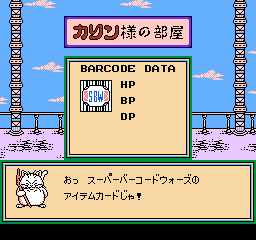
More curious still, this range occupies the same slots assigned to the Dragon Ball cards (the one-star through seven-star balls). Those cards are skipped by the item-effect table, and the proprietary format uses the space they left.
The obvious question follows: why can a Dragon Ball game read cards from another series — one that includes another company's characters? The answer is clear enough. It was built that way from the start.
The plainest evidence is the one just seen: the game says the product's name out loud. Merely being readable could be coincidence. Preparing a dedicated logo and writing dedicated dialogue for it is another matter entirely.
The timeline agrees. This Datach title shipped on 29 December 1992. The Super Barcode Wars cards ran from December 1992 to November 1993, 230 varieties including those bundled with the device. Same month, same company, two product lines running side by side. This was not retrofitted.
The program says the same thing. An entire separate read path exists for this format, and the retail-barcode calculation is bypassed. On top of that, the test that excludes the Dragon Ball cards from the item-effect table and the arithmetic that drops this format into the space they vacate exist as a matched pair. Leftovers and coincidence do not line up like that.
That said, there is no sign anyone decided which card should produce which result. That is precisely why a card from another company's series yields a Perfect Cell with numbers no retail barcode can reach. The reading mechanism was built; what came out of it was never tuned — which seems the closest reading of the evidence (this is the author's interpretation, with nothing conclusive behind it).
This subject invites overstatement, so here is what could not be done.
When this was first investigated, the author concluded that "99990 cannot be generated; this cannot happen." That was wrong. The display-side saturation had not been checked, and internal values were assumed to map straight onto the screen.
Information from others, and their corrections, broke that assumption and led to the conclusions above. The record is kept here because the same assumption is an easy one to make.
The tip about the Dr. Wily card quoted at the top of this page came from Tareichi (たれいち, @tareichi001).
The supporting evidence offered was a video published on Niconico as real-hardware play: 【FC】データック_ドラゴンボールZ_強3RTA_06:16 (sm36113889, posted by sion10, 21 December 2019, accessed 14 August 2026). The entrant registration screen shows Cell with HP 99990, BP 99990, DP 99990 and technique level 1.